Running a business in San Francisco is no small feat. Between managing staff, handling customers, and keeping operations smooth, the last thing any business owner needs is a commercial roll-up door that decides to give out at the worst possible moment.
Picture this: It’s Monday morning in SoMa. A delivery truck is idling outside. Employees are standing around. And the roll-up door is stuck halfway open or worse, won’t budge at all. That’s not just an inconvenience. That’s lost time, lost money, and a real headache.
Commercial roll-up doors take a serious beating in San Francisco. The Bay Area’s coastal fog, salt air blowing in from the Bay, constant temperature changes, and the sheer volume of daily use in busy neighborhoods like the Mission, Chinatown, Dogpatch, and the Financial District all add up. These doors work hard, and over time, they show it.
The good news? Most commercial roll-up door problems don’t happen without warning. There are almost always signs before a full breakdown occurs. Knowing what to look for can be the difference between a quick, affordable repair and a costly emergency replacement.
The most common signs that a commercial roll-up door needs repair include unusual noises, slow or uneven movement, visible panel and track damage, a door that won’t stay in position, and a motor that runs without the door actually moving. Spotting these early can save San Francisco business owners thousands of dollars in emergency repair or full replacement costs.
Here are the five signs every commercial property owner and manager in San Francisco should know.
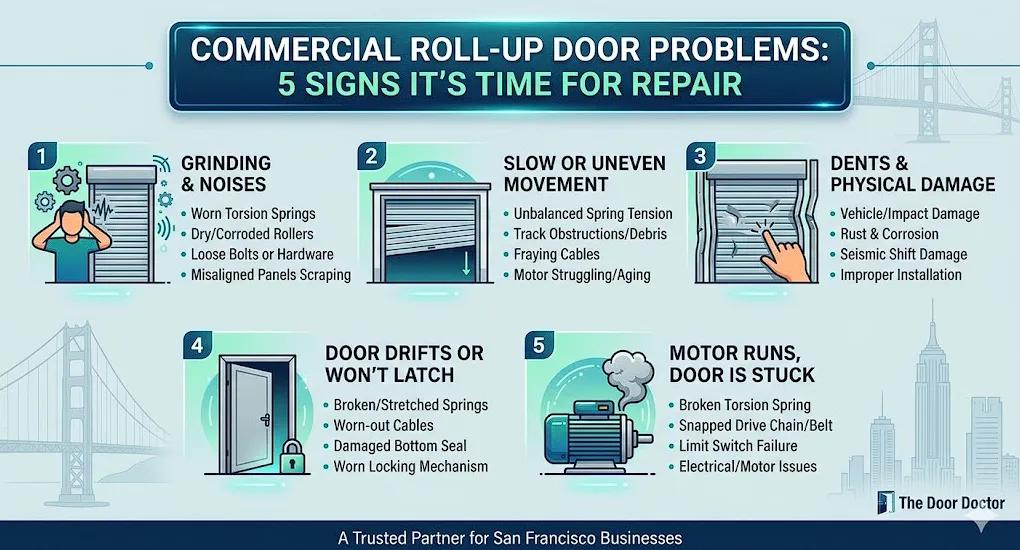
Sign #1: Grinding, Squealing, or Banging Noises You Can’t Ignore
A commercial roll-up door should open and close with a consistent, relatively quiet hum. So when grinding, squealing, or loud banging starts happening on every cycle, that noise is the door’s way of saying something is wrong.
What it sounds like:
Grinding metal on metal when the door moves. A high-pitched squeal as it rolls up. A heavy bang or clunk when it reaches the bottom. Sometimes it’s a rhythmic rattling that gets louder over time. Any of these sounds deserves immediate attention.
Why it happens:
The most common culprits behind noisy commercial roll-up doors include:
- Worn or broken torsion springs that have lost their tension
- Dry, corroded, or damaged rollers that no longer glide smoothly through the tracks
- Loose hardware, like bolts, hinges, or brackets, that vibrate during operation
- Misaligned door panels scraping against the frame on the way up or down
In San Francisco specifically, coastal humidity and heavy morning fog accelerate corrosion on metal components. Businesses located near the Embarcadero, Fisherman’s Wharf, or the Port of San Francisco deal with salt air on a daily basis. That salt air speeds up rust and wear on every metal part of the door system, often faster than businesses expect.
What to check:
Start by listening carefully to where the noise is coming from. Sounds from the top of the door usually point to spring issues. Noise coming from the sides suggests rollers or tracks. A banging or scraping near the bottom often means the door seal or bottom panel is the problem.
Do a visual inspection of rollers and hinges. Look for rust, cracks, or pieces that seem out of place. Check whether any bolts on the track system are visibly loose.
Tips to avoid the problem:
Lubricate all moving parts every three to six months. Use a silicone-based lubricant on rollers, hinges, and tracks. Avoid using WD-40 as a long-term solution because it attracts dirt and grime, which creates more friction over time.
Have a qualified technician inspect the springs at least once a year. Torsion springs are under extreme tension and are not something to assess or adjust without professional training.
What to do:
Grinding and banging noises usually mean metal-on-metal contact that gets worse with every single cycle. A professional inspection can identify the root cause before it turns into a full spring replacement, track realignment, or worse, a door that fails mid-operation during business hours.
Average repair costs for spring and roller work fall in the lower-to-mid range when caught early. Waiting turns those manageable repairs into much larger bills.
For a deeper look at what those sounds actually mean, check out this related read: Why Is My Roll-Up Door Making Grinding Noises.
Sign #2: Slow, Jerky, or Uneven Movement When Opening or Closing
A commercial roll-up door that takes longer than usual to open, or one that stutters and jolts as it moves, is not just annoying. It’s a warning sign that something mechanical is off.
What it looks like:
One side of the door rises slightly faster than the other, creating a visible tilt. The door hesitates at certain points as if it’s catching on something. It feels like the door is fighting against itself. Sometimes the door starts strong and then slows dramatically before reaching the top.
Why it happens:
Uneven or slow movement typically comes down to a few specific causes:
- Unbalanced spring tension where one spring is weaker or more worn than the other
- Obstructions or debris stuck inside the tracks block smooth movement
- Worn or fraying cables that can no longer support even weight distribution
- A motor that is aging or struggling due to years of heavy use
In high-traffic commercial zones like the Financial District, Dogpatch, and Bayview-Hunters Point, commercial doors often cycle dozens of times per day. That volume of use puts constant stress on cables and springs, and wear doesn’t always happen evenly on both sides.
What to check:
Watch the door from a safe distance as it opens. Does one side lift higher before the other catches up? That tilt is a sign of spring or cable imbalance.
Look inside the tracks for debris, small rocks, built-up grime, or anything that could be creating friction or a physical block. Loading dock areas are especially prone to this kind of buildup.
Check the cables on both sides of the door. Look for any fraying, kinking, or sections that appear slack when the door is closed.
Tips to avoid the problem:
Keep tracks clear and clean. A quick visual check of the track area a few times a week takes less than a minute and can catch debris before it causes damage.
Every few months, test the door’s balance by disconnecting the motor and manually lifting the door a few inches. A balanced door stays in place. A door that falls back down quickly has a tension problem. Only do this when no one is near the door.
Never ignore a slow-moving door. Every cycle where the door struggles puts extra strain on the motor, cables, and springs, shortening the lifespan of all three.
What to do:
Uneven movement is almost always a cable or spring issue underneath the surface. Left unaddressed, that imbalance can snap a cable mid-cycle. In a busy commercial setting, that means the door could come down unexpectedly, creating both a safety hazard and a full operational shutdown.
Cable and spring balancing is a mid-range repair cost. Emergency after-hours service in San Francisco runs significantly higher.
A malfunctioning door also puts the entire property at risk beyond just mechanical failure. Learn more in this related article: Can a Damaged Roll-Up Door Affect Business Security.
Sign #3: Dents, Bent Panels, or Damaged Tracks That Keep Getting Worse
Some damage is easy to dismiss as cosmetic. A small dent here. A slightly bent panel there. But with commercial roll-up doors, physical damage almost always affects function over time.
What it looks like:
Dented slats that don’t roll up cleanly and catch on other panels. A track that’s slightly bowed or has pulled away from the wall. Panels that look warped or leave visible gaps along the sides or bottom when the door is fully closed.
Why it happens:
Physical damage to commercial roll-up doors is often the result of:
- Forklift or delivery truck impact, which is extremely common in warehouses and loading dock environments
- Rust that has eaten through panels over time, weakening the structure
- Improper installation that creates stress points in certain areas of the door
- Seismic activity, which San Francisco business owners understand better than most
The Bay Area sits on active seismic zones. Subtle structural shifts from earthquakes, even minor ones, can bend tracks, loosen wall brackets, and stress panels in ways that aren’t immediately visible. Combined with the city’s aging commercial building stock in areas like the Warehouse District, Mission Bay, and older parts of SoMa, panel and track damage is more common in San Francisco than in newer suburban commercial markets.
What to check:
Inspect all panels visually from both the inside and outside of the building. Look for dents, cracks, warping, or rust spots that have spread.
Run a hand along both tracks. Feel for bends, gaps, rough spots, or sections where the track has pulled away from the wall mount. These are signs the track has shifted or been impacted.
Pay close attention to where the track meets the wall bracket. These fasteners are load-bearing points, and they loosen over time, especially in older buildings or after any seismic activity.
Tips to avoid the problem:
Install door guards or steel bollards near high-traffic loading areas to protect the door from vehicle impact. This is a low-cost preventative measure that can prevent thousands of dollars in door damage.
Add reflective markers or painted clearance indicators on the floor and walls near loading docks to help drivers judge their approach distance accurately.
After any earthquake, even a small one, do a quick visual inspection of the full door system before resuming normal operation. Catching a shifted bracket early prevents track failure later.
What to do:
A bent panel may look like a minor cosmetic issue, but it can jam the entire door mid-cycle by interfering with how the slats stack or roll. Bent tracks are more serious. They put uneven pressure on the rollers with every single movement, which can lead to a complete track derailment.
Single-panel replacements fall in the more affordable range of commercial door repairs. Full track realignment or replacing multiple panels costs more. Acting early keeps costs manageable.
Bent panels and damaged tracks are also among the top reasons a door fails to open all the way. Find out more in this related read: What Causes a Roll-Up Door to Stop Opening Fully.
Sign #4: A Door That Drifts, Drops, or Refuses to Latch Properly
A commercial roll-up door that won’t stay where it’s supposed to be is more than an inconvenience. It’s a security risk, a safety issue, and in some cases, a liability problem.
What it looks like:
The door is raised and then slowly drifts back down on its own. Or it’s closed, but there’s a visible gap along the bottom or sides that wasn’t there before. Sometimes the door simply won’t latch or lock, leaving the property exposed.
Why it happens:
A door that won’t hold its position usually comes down to one of these causes:
- Broken or stretched torsion springs that can no longer hold the door’s weight at any given position
- Worn-out or snapped cables that fail to provide consistent tension
- A damaged or compressed bottom seal that prevents the door from resting flush against the floor
- A locking mechanism that has worn down, shifted, or failed entirely
San Francisco Context:
Commercial security is a legitimate and ongoing concern for business owners across San Francisco neighborhoods. A door that won’t stay fully closed creates a real vulnerability, especially for businesses in high-traffic areas or locations that have experienced property crime.
Beyond security, a door that leaves gaps at the bottom also fails to keep out San Francisco’s notoriously damp air, fog, and rain. That kind of moisture intrusion causes rust, floor damage, and inventory issues for businesses that store products near the door.
A door that doesn’t close properly can also become a compliance issue during commercial property inspections.
What to check:
With the motor disconnected and proper caution in place, test whether the door holds its position at the halfway point. A door that slides back down immediately has a spring or cable tension problem.
Inspect the bottom seal for cracking, gaps, uneven compression, or sections that have torn away. The seal should create a consistent contact with the floor across the entire width of the door.
Check the lock bar and slide bolts for alignment. If they’re not lining up with their receiving points, the door has likely shifted, or the mounting has loosened.
Tips to avoid the problem:
Replace worn bottom seals before they cause closure and sealing problems. Seals are one of the lowest-cost parts of a commercial door system and one of the most commonly neglected.
Schedule spring and cable inspections after heavy use periods. For retail businesses in San Francisco, the post-holiday season is a smart time to check. For warehouses and distribution operations, the end of summer works well.
Lubricate and test all locks and latches regularly to make sure they engage and release cleanly.
What to do:
A door that won’t stay closed is a problem that should be treated as urgent. Beyond the obvious safety risk, it could create issues with commercial property insurance coverage if damage or theft occurs and the door is documented as malfunctioning beforehand.
Seal replacements are among the lowest-cost commercial door repairs. Adding spring or cable replacement increases the cost, but both are still well below a full door replacement.
Sign #5: The Motor Runs But the Door Doesn’t Move
This one is particularly alarming because everything sounds like it’s working until it becomes clear the door isn’t going anywhere.
What it looks like:
The button gets pressed. The motor hums or strains. And nothing happens. Or the door shifts an inch and then stops completely. The motor keeps running, but the door is frozen in place.
Why it happens:
A motor that runs without moving the door points to one of several issues:
- A broken torsion spring is the most common cause. The motor is not designed to lift the full weight of a commercial roll-up door on its own. Springs carry most of that load, and when one breaks, the motor physically cannot compensate.
- A disconnected or snapped drive chain or belt that has broken the link between the motor and the door mechanism
- A limit switch failure where the system believes the door is already in the correct position when it isn’t
- Electrical issues or a motor that is beginning to burn out from years of use
San Francisco Context:
Power fluctuations during storms and the occasional grid strain that comes with the city’s aging infrastructure can put added stress on commercial door motors. Older commercial buildings in SoMa, the Tenderloin, and Chinatown are more likely to have electrical systems that weren’t designed for the load demands of modern commercial door motors, which accelerates wear and shortens motor lifespan.
What to check:
Listen closely to the motor. A loud straining hum usually means the motor is working hard against resistance, often from a broken spring. A barely-turning or clicking sound suggests an electrical or mechanical connection problem.
Locate the emergency release cord, typically a red cord hanging from the motor unit, and gently test whether the door can be moved manually. If it moves freely by hand, the motor or its drive connection is the issue. If it feels extremely heavy or won’t move at all, a broken spring is the likely culprit.
Look at the drive chain or belt for visible breaks, excessive slack, or sections that have come off the track entirely.
Tips to avoid the problem:
Have the motor serviced every one to two years by a qualified technician. Like any piece of mechanical equipment, regular maintenance extends its lifespan significantly.
Never repeatedly press the button when the door isn’t responding. Every attempt to run a struggling motor causes additional wear and heat damage. One attempt, then stop and call a professional.
Consider installing a surge protector on the motor unit, especially in older San Francisco buildings where power quality can be inconsistent.
What to do:
A motor that runs without moving the door is almost always masking a spring failure underneath. Continuing to run the motor under those conditions turns what could be a straightforward spring replacement into a spring plus motor replacement, a significantly higher repair cost.
Motor repairs and spring replacements together fall in the mid-to-higher range of commercial door repair costs. Still, that number is a fraction of what a full commercial roll-up door replacement runs in the San Francisco market.
How San Francisco Businesses Can Extend the Life of Their Commercial Roll-Up Door
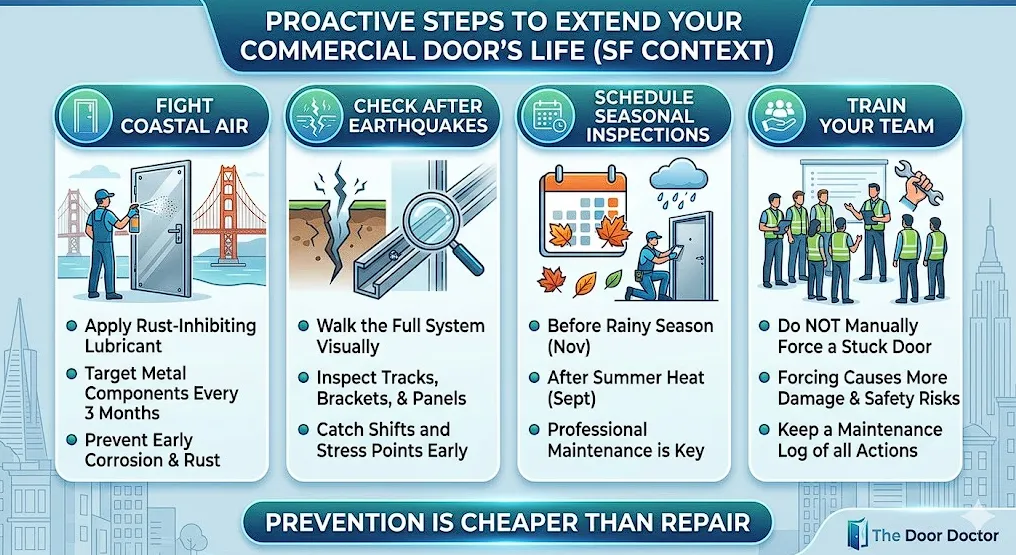
Prevention is always less expensive than repair. Here are practical habits that San Francisco commercial property owners and managers can put in place starting today.
- Fight the coastal air: Bay Area fog and salt air accelerate rust and corrosion faster than in inland markets. Apply a rust-inhibiting lubricant to all metal components every three months, not just once a year.
- Check after every earthquake: After any notable seismic event, walk the full door system and look at tracks, wall brackets, and panels for signs of shift or stress. Small problems caught right after a tremor are much easier and cheaper to fix.
- Schedule seasonal inspections: The two best times for a professional inspection in San Francisco are before the rainy season begins in November and after the summer heat in September. These are the periods when wear and damage are most likely to show up.
- Train the team: Employees should never manually force a stuck door. Forcing a jammed commercial roll-up door almost always causes more damage than the original problem and can create a serious safety risk.
- Keep a maintenance log: Documenting every inspection, lubrication, and repair creates a paper trail that strengthens warranty claims, supports insurance coverage arguments, and helps technicians diagnose recurring issues faster.
Don’t Wait Until It’s Too Late
Commercial roll-up doors are built to be tough, but they are not maintenance-free. The five warning signs covered here are unusual noises, slow or uneven movement, visible panel and track damage, a door that won’t stay in position, and a motor that runs without the door responding, all of which are messages that something needs attention.
In a city like San Francisco, where commercial real estate costs are high, business margins are tight, and operations can’t afford unexpected downtime, staying ahead of door problems is simply smart business. A small repair handled quickly stays small. Ignored, those same problems grow into expensive emergencies that disrupt everything.
Any San Francisco business owner noticing one or more of these signs should have a local commercial door technician take a look before the situation escalates. This applies whether the property is running a commercial roll-up door, a commercial hollow metal door, or any other door system built for heavy daily use. The inspection itself is a minor investment compared to what a full breakdown during business hours actually costs.
Your Trusted Commercial Roll-Up Door Repair Experts in San Francisco
That is where The Door Doctor comes in. Serving San Francisco and the greater Bay Area, we have built a trusted reputation for fast, honest, and professional commercial roll-up door repair and maintenance. Our team understands the unique demands that Bay Area weather, aging building stock, and high-volume commercial use place on door systems every single day. From a squealing spring to a full track realignment, we bring the right experience and the right parts to get the job done right the first time, with zero guesswork and no unnecessary upselling. Do not let a small door problem turn into a costly shutdown. Contact us today or give us a call to schedule a professional inspection for your commercial roll-up door in San Francisco. We are ready to help keep your business running without missing a beat.